
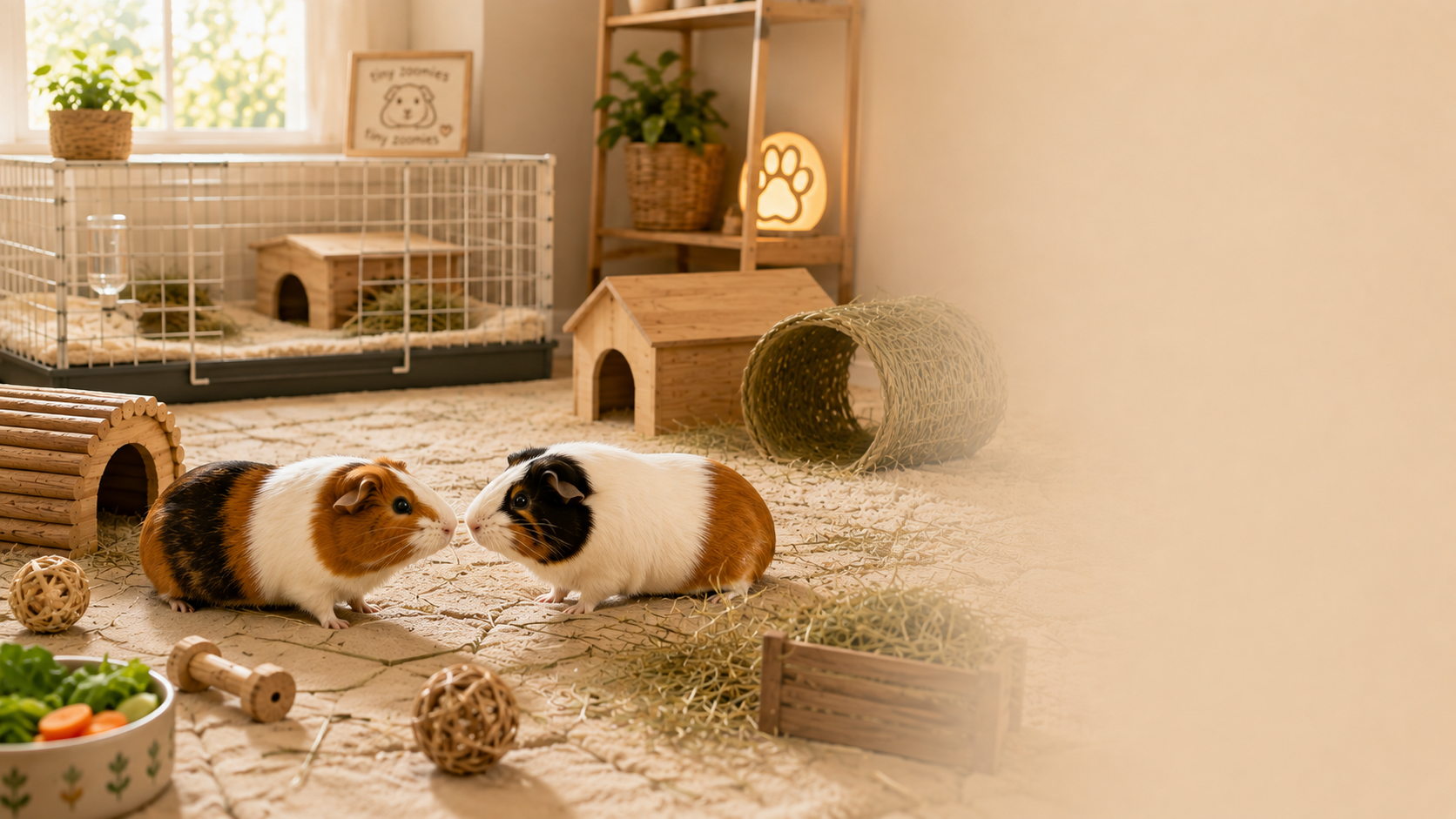
You’ve decided your guinea pig needs a friend. You’ve found a sweet companion, prepared the supplies, and you’re excited to see them become best buddies.
Then comes the big question:
How do you actually introduce them without turning the first meeting into a tiny furry drama?
Guinea pigs are social animals, but that doesn’t mean every introduction is instant friendship. Your resident piggy may be curious, nervous, territorial, bossy—or all four before lunchtime.
The good news is that a thoughtful introduction can give both guinea pigs the best possible chance to form a strong bond.
In this guide, we’ll walk through the process step by step, including what to do before they meet, how to choose neutral territory, which behaviors are normal, when you should intervene, and how to know when they’re ready to live together.
Disclosure: This article contains affiliate links. As an Amazon Associate, Tiny Zoomies earns from qualifying purchases at no additional cost to you.
🐹 First: Don’t Just Put the New Guinea Pig in the Existing Cage
This is probably the most important rule of the entire introduction process.
Your resident guinea pig already considers their enclosure home. It contains familiar smells, favorite sleeping areas, food stations, hideouts, and established routines.
Putting an unfamiliar guinea pig directly into that space can create unnecessary territorial tension.
Instead, think of the first meeting as a neutral introduction rather than a housewarming party.
A neutral area should be somewhere neither guinea pig considers their established territory.
🩺 Step 1: Make Sure the New Guinea Pig Is Ready
Before introducing a new guinea pig to an established companion, give the newcomer time to settle in and monitor their health.
A new arrival has already experienced a major change—new surroundings, new smells, new sounds, and a new routine. Rushing the process can add unnecessary stress.
If you’re adopting from a rescue, ask about the guinea pig’s health history and any recommended quarantine or veterinary precautions.
If you’re uncertain about whether your new guinea pig is healthy enough to meet your existing piggy, talk with an exotic-animal veterinarian before proceeding.
Remember: bonding should never come at the expense of health and safety.
👀 Step 2: Let Them See and Smell Each Other First
Instead of jumping immediately into face-to-face contact, give both guinea pigs an opportunity to become familiar with the idea of another piggy being nearby.
If practical, house them in separate secure spaces where they can safely become accustomed to each other’s presence without being able to bite through bars.
You can also introduce familiar scents by swapping appropriate bedding or other safe items between their spaces.
Watch for curiosity rather than expecting instant affection.
Positive Signs Can Include:
- Sniffing toward the other guinea pig
- Relaxed interest
- Soft vocalizations
- Spending time near the divider
- Eating normally while the other guinea pig is nearby
- Showing increasing curiosity over time
Some guinea pigs will seem fascinated. Others may act as if the newcomer doesn’t exist.
Either response can be perfectly normal.
🏡 Step 3: Prepare a Neutral Bonding Area
When it’s time for the first face-to-face meeting, choose an area that neither guinea pig normally claims as their own.
This could be a securely enclosed area in a room they don’t normally use, provided the space is safe, clean, escape-proof, and easy for you to supervise.
Your Bonding Area Should Have:
- Plenty of open floor space
- Large piles of hay
- Scattered safe vegetables or treats
- Good traction underfoot
- No dangerous gaps or escape routes
- Hideouts with more than one exit if you use them
The goal is to give both guinea pigs room to move away from each other without allowing either one to become trapped.
Avoid small enclosed hideouts with only one entrance during the initial introduction. A guinea pig that feels cornered has fewer options for avoiding conflict.
🛒 Helpful Bonding Supplies
You don’t need to buy a mountain of equipment to introduce guinea pigs, but a few inexpensive supplies can make the process easier.
1. A Secure Exercise Pen
A modular small-animal exercise pen gives you a controlled space where you can observe the guinea pigs while giving them room to move.
👉 Shop Guinea Pig Exercise Pens on Amazon
2. Natural Wooden Hideouts
For bonding sessions, choose shelters that don’t create dead ends or narrow spaces where one guinea pig can trap another.
👉 Shop Guinea Pig Wooden Hideouts on Amazon
3. Hay for the Bonding Area
A generous pile of hay gives both guinea pigs something positive and familiar to focus on while they investigate each other.
4. Multiple Food and Water Stations
Once the guinea pigs are eventually living together, duplicate important resources so one piggy cannot easily control access to food or water.
👉 Shop Small-Animal Ceramic Bowls on Amazon
🐹 Step 4: Let Them Meet
When the space is ready, place both guinea pigs into the neutral area and allow them to investigate each other.
This is the part where human patience becomes extremely important.
You may see a surprising amount of sniffing, following, vocalizing, chasing, mounting, or other dominance-related behavior.
It can look dramatic to us.
But dramatic does not automatically mean dangerous.
Guinea pigs need to establish their social relationship, and some behaviors that look alarming to a new owner can occur during that process.
👑 Step 5: Learn the Difference Between Dominance and Fighting
This is one of the hardest parts for first-time guinea pig parents.
Behaviors You May See During Normal Social Negotiation
- Sniffing
- Following
- Chasing
- Rumble-strutting
- Mounting
- Head raising
- Short periods of teeth chattering
- Brief nipping without injury
- Ignoring each other
These behaviors can be part of establishing a hierarchy.
🚨 Behaviors That Require Immediate Attention
- Repeated lunging
- Serious biting
- Open-mouth aggression
- Persistent, escalating teeth chattering
- Fighting that does not stop
- Blood or visible injury
If a serious fight breaks out, do not put your bare hands between fighting guinea pigs. Use an appropriate barrier or towel to separate them safely and assess whether either guinea pig has been injured.
If you’re unsure whether the interaction is normal dominance behavior or dangerous aggression, stop and seek guidance from an experienced guinea pig rescue, bonding service, or exotic-animal veterinarian.
🌾 Step 6: Make Food Part of the Friendship
Food can help create a positive environment during introductions.
Instead of putting a single prized food bowl in the middle of the area, scatter hay and small amounts of appropriate food around the space.
This encourages both guinea pigs to forage and explore rather than compete over one resource.
And let’s be honest—few guinea pigs are above making a new friend if there’s hay involved.
⏰ Step 7: Don’t Rush the Process
One of the biggest mistakes owners can make is deciding that the introduction has “failed” because the guinea pigs aren’t cuddling immediately.
They don’t need to become best friends in five minutes.
They need time to figure each other out.
Some guinea pigs settle quickly. Others require a slower process with more observation and patience.
Pay attention to the overall pattern rather than one isolated interaction.
💛 Step 8: Look for the Beautiful Signs of Acceptance
As the relationship develops, you may begin to notice subtle changes.
Wonderful Signs Include:
- Eating near each other
- Choosing to rest nearby
- Grooming each other
- Following each other calmly
- Relaxing in the same area
- Exploring together
- Sleeping near each other
One of the sweetest moments is when you realize that your new guinea pig is no longer “the new guinea pig.”
They’re simply part of the herd.
🏠 Step 9: Prepare Their Shared Home
Once the guinea pigs have successfully bonded, their permanent living space should be prepared with both animals in mind.
A shared enclosure should provide enough room for both guinea pigs to move, eat, rest, and retreat without constantly competing for the same resources.
Think in Multiples:
- Multiple hay piles
- Multiple water sources
- Multiple food areas
- Multiple resting spots
- Multiple hideouts
If you are using hideouts, tunnels, or houses, provide options that allow guinea pigs to enter and leave without creating easily defended dead ends.
For more help designing the environment itself, see our guide:
😳 What If They Don’t Like Each Other?
Sometimes guinea pigs simply don’t form the relationship we hoped for.
That doesn’t mean you’ve failed.
Guinea pigs have individual personalities, preferences, and social dynamics. A pairing that looks perfect on paper may not work in practice.
If the introduction repeatedly becomes dangerous, stop and seek professional guidance rather than repeatedly forcing the guinea pigs together.
A rescue organization experienced in guinea pig bonding may be able to help evaluate the pairing and recommend the safest next step.
📖 The Blueberry & Ginger Connection
There’s a very special reason this topic belongs on Tiny Zoomies.
Blueberry Meets Ginger was inspired by the real-life idea of bringing a new guinea pig into an existing piggy’s world.
The story follows Blueberry as he meets Ginger and introduces young readers to the importance of patience, gradual introductions, individual attention, neutral territory, and supervised interaction.
It’s a natural companion to this guide—especially for families introducing a new guinea pig and wanting children to understand why the process shouldn’t be rushed.
📖 Read or purchase Blueberry Meets Ginger

You can also explore Blueberry’s New Home, which introduces children to the experience of bringing a guinea pig into a new home and creating a safe, loving environment.
📘 Read or purchase Blueberry’s New Home

🔗 More Tiny Zoomies Guides to Help You
The Ultimate Guinea Pig Cage Setup Guide
— Create a spacious environment where multiple guinea pigs can comfortably live together.
The Guinea Pig Happiness Blueprint
— Learn the everyday habits that help guinea pigs feel secure and happy.
Piggy Wellness Journal
— Keep track of health and behavior changes as your guinea pigs settle into life together.
Bonded for Life: How to Get the Social Side of Guinea Pigs Right
— A broader look at why companionship matters.
Guinea Pig Personality Types: Which One Do You Have?
— Understanding each piggy’s individual personality can help you appreciate their unique social dynamics.
🎥 See More Tiny Zoomies Piggy Moments
Want to see guinea pigs exploring, wheeking, popcorning, and showing off their personalities?
🐹 New Friend, New Beginning
Introducing a new guinea pig isn’t about forcing two animals to become friends.
It’s about giving them the time, space, resources, and safety they need to decide whether they can build a relationship.
There may be wheeks.
There may be chasing.
There may even be a little bit of guinea pig drama.
But when you eventually see two little noses meeting, two piggies sharing a hay pile, or two furry friends settling down beside each other, you’ll understand why the patience was worth it.
Because sometimes the beginning of a beautiful friendship starts with nothing more than two guinea pigs, a safe space, and a little time. 💛

Leave a Reply