
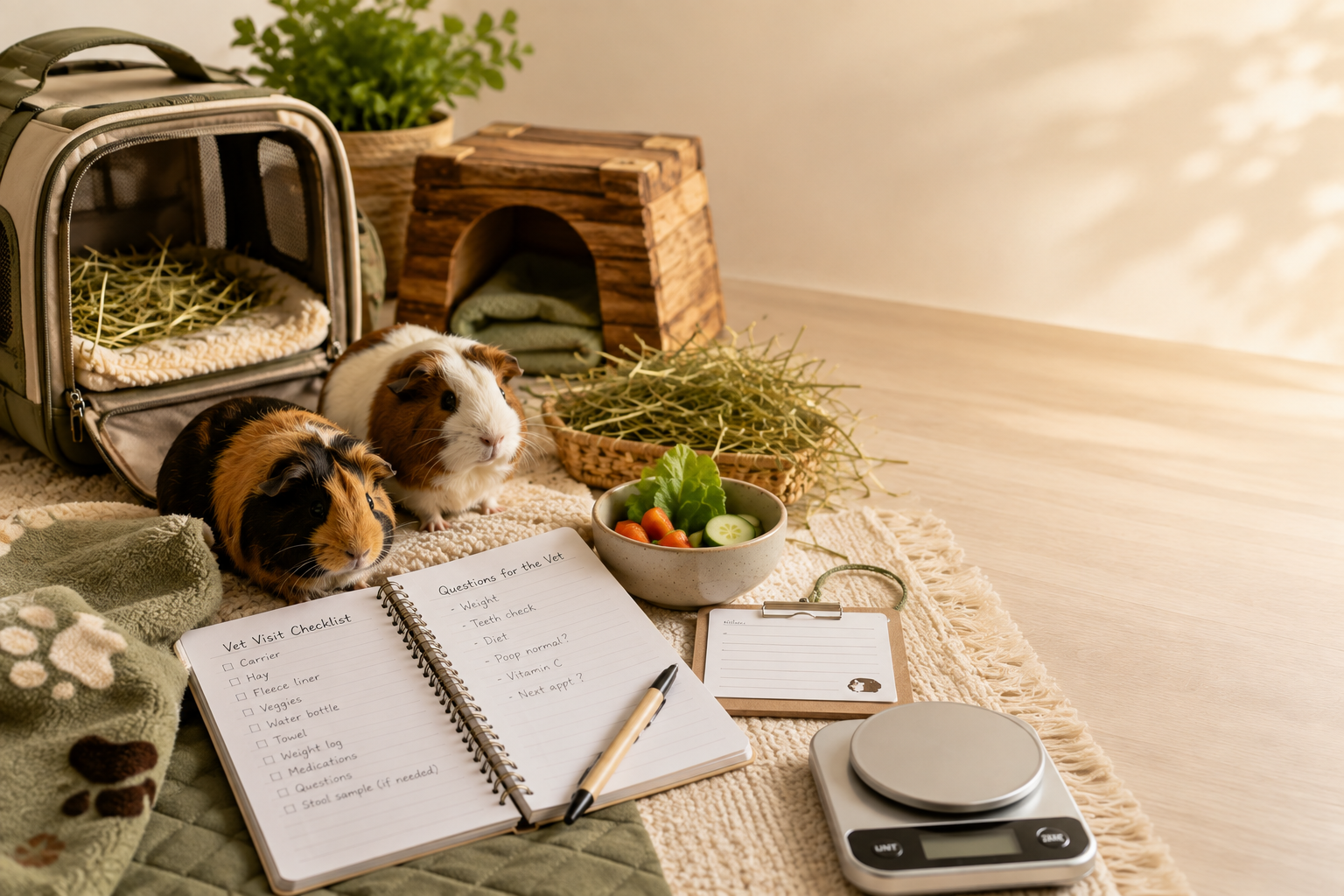
A guinea pig vet visit can feel stressful for both you and your little potato. The carrier comes out, your piggy disappears into a hideout, and suddenly you’re trying to remember every question you wanted to ask the veterinarian.
But a little preparation can make the entire experience much smoother.
Whether you’re taking your guinea pig for a routine wellness exam, a follow-up appointment, a new-pet checkup, or because something seems off, having a simple vet visit plan means less scrambling and more useful information for your veterinarian.

Disclosure: Tiny Zoomies may earn a commission from qualifying purchases made through Amazon affiliate links, at no additional cost to you.
Why a Guinea Pig Vet Visit Deserves a Little Preparation
Guinea pigs are small prey animals, and they can hide signs of illness surprisingly well. A veterinary appointment is therefore an important opportunity to give your veterinarian a clear picture of what is normal for your piggy and what has changed.
Veterinary sources recommend routine veterinary care for guinea pigs, with at least annual wellness examinations commonly advised for healthy small mammals. Older animals may need more frequent monitoring depending on their individual health and their veterinarian’s recommendations.
For a guinea pig who is nervous outside the home, the goal is not to make the appointment completely stress-free. The goal is to make the trip predictable, secure, and as calm as reasonably possible.
For more emergency-focused preparation, see our Guinea Pig Emergency Kit guide.
🐹 Your Guinea Pig Vet Visit Checklist
Before leaving the house, make sure you have:
- ☐ A secure, well-ventilated carrier
- ☐ Familiar fleece or bedding
- ☐ Plenty of hay
- ☐ A small amount of your piggy’s usual food
- ☐ A towel or fleece blanket
- ☐ Your veterinarian’s phone number
- ☐ Current medications or supplements, if applicable
- ☐ A list of recent symptoms or behavioral changes
- ☐ Recent weight information
- ☐ Photos or videos of anything unusual you have observed
- ☐ Any requested stool sample or other specimen
- ☐ A list of questions you want answered
That may sound like a lot, but once you turn it into a reusable little “vet bag,” most of the process becomes automatic.
1. Choose the Right Carrier
Your guinea pig should travel in a secure, species-appropriate carrier rather than being held loose in the car.
Look for:
- Good ventilation
- A secure door or opening
- A solid floor
- Enough room for your guinea pig to sit comfortably
- A design that allows easy access without excessive handling
A hard-sided small-animal carrier can be particularly practical for veterinary trips because it provides a stable enclosure and is easier to clean.
🛒 Shop guinea pig and small-animal carriers on Amazon
Tiny Zoomies Tip: Don’t wait until appointment morning to introduce a new carrier. Leave it open in your guinea pig’s normal environment ahead of time so it becomes a familiar object rather than a mysterious box that suddenly appears before a stressful outing.
Our Guinea Pig Travel Guide has more ideas for making transportation calmer and more predictable.
2. Make the Carrier Feel Familiar
Your guinea pig doesn’t need a luxurious travel suite. Familiarity is much more valuable.
Consider placing inside the carrier:
- Usual fleece or bedding
- A generous pile of hay
- A familiar towel or small fleece piece
- A favorite hide or tunnel if there is enough room for safe transport
A familiar smell can make an unfamiliar environment feel a little less strange.
Avoid making major environmental changes immediately before a vet appointment. The goal is familiarity, not experimentation.
3. Bring Hay and Your Piggy’s Usual Food
Guinea pigs have sensitive digestive systems, and sudden dietary changes can cause problems. Veterinary guidance recommends making food changes gradually rather than abruptly.
That makes the vet-trip rule very simple:
Bring what your guinea pig already knows.
Pack their normal hay and, when appropriate, a small amount of their usual food or vegetables according to your veterinarian’s instructions.
For your complete nutrition basics, see the Tiny Zoomies Ultimate Guinea Pig Diet Guide.
4. Bring a Weight History
One of the most useful things you can bring to a veterinary appointment is information about your guinea pig’s recent weight.
Rather than saying, “I think he feels lighter,” you can tell your veterinarian exactly what you have observed:
- “He weighed 1,050 grams last month.”
- “She has gradually decreased in weight over several weeks.”
- “Her weight has remained stable.”
That kind of information gives your veterinarian a much clearer starting point.
A simple digital kitchen scale that measures in grams can be useful for routine home monitoring when your veterinarian has recommended weight tracking.
⚖️ Shop digital gram scales on Amazon
Our Piggy Wellness Journal is also a great companion for recording weights and other observations over time.
5. Write Down What You’ve Actually Seen
This is one of the biggest ways you can help your veterinarian.
Instead of trying to remember everything during the appointment, make a quick note before leaving home.
Write down:
- When the problem started
- What changed
- Whether appetite changed
- Whether drinking changed
- Changes in droppings or urination
- Changes in activity
- Changes in behavior
- Changes in vocalization
- Any recent weight changes
- Anything else that seems unusual
Even a note that says “Started Tuesday evening after dinner” can be more useful than trying to reconstruct the timeline from memory.
6. Take Photos and Videos
Some behaviors disappear the moment you arrive at the veterinary clinic.
Your guinea pig may spend the entire appointment looking perfectly innocent.
That’s where your phone can become extremely useful.
Take short videos of unusual behaviors at home when it is safe to do so.
Examples might include:
- An unusual breathing sound
- A change in walking
- Odd eating behavior
- A strange repetitive movement
- An unusual vocalization
- Something you noticed during normal activity
Showing your veterinarian what you observed in the home environment can provide useful context.
For the same reason, photos of your guinea pig’s habitat can sometimes help provide additional context about diet, bedding, enclosure layout, or other environmental factors.
7. Bring a Medication and Supplement List
If your guinea pig takes any medication or supplements, write down:
- The product name
- The amount given
- How often it is given
- When the last dose was given
- Who prescribed it, if applicable
Even if you think the veterinarian already has this information, having it written down reduces the chance of forgetting an important detail.
8. Prepare Your Questions Before You Arrive
Veterinary appointments can move quickly, especially when you’re nervous.
Before you leave home, put your questions in your phone or on a piece of paper.
Here are some useful prompts:
- “Is my guinea pig’s weight where you would expect it to be?”
- “Does the diet need to be adjusted?”
- “How often would you like us to monitor weight?”
- “Is this behavior normal for this guinea pig?”
- “What signs should make me call you?”
- “When should we schedule the next examination?”
- “Are there any changes you recommend at home?”
And never worry about asking a “stupid” question. A good question asked early is far better than sitting at home wondering what the veterinarian meant.
9. Keep the Ride Calm
During the trip, think about your guinea pig’s environment.
- Secure the carrier so it cannot slide around.
- Avoid direct sunlight on the carrier.
- Keep the vehicle comfortably ventilated.
- Avoid blasting hot or cold air directly onto your guinea pig.
- Drive smoothly and avoid unnecessary sudden movements.
- Keep excessive noise to a minimum.
Guinea pigs are sensitive to temperature extremes, and veterinary guidance recommends particular care during transportation in very hot or very cold weather.
For longer drives, our travel guide covers additional preparation.
10. Don’t Over-Handle Your Guinea Pig Before the Examination
It’s completely understandable to want to reassure your piggy by constantly picking them up.
But more handling isn’t necessarily more comforting.
Guinea pigs can become stressed when handled excessively, particularly when they are frightened or already uncomfortable.
Instead, keep the environment calm and let your veterinarian perform the examination using appropriate handling techniques.
Merck Veterinary Manual notes that guinea pigs generally require minimal restraint for a physical examination, and that handling should be adjusted when an animal is stressed or in pain.
11. Let the Veterinarian Know What “Normal” Looks Like
You know your guinea pig better than anyone else in the room.
That makes your observations valuable.
Tell the veterinarian about your piggy’s normal:
- Eating habits
- Activity level
- Personality
- Usual vocalizations
- Bathroom habits
- Favorite foods
- Typical sleeping behavior
For example:
“He has always been shy, but this is different because normally he comes out immediately when he hears the refrigerator.”
That distinction can be very helpful.
And it connects beautifully with our Guinea Pig Personality Types guide, especially when explaining what is normal behavior for your individual piggy.
12. Ask What Happens Next
Before leaving the appointment, make sure you understand the plan.
Ask:
- What should you do at home?
- What changes should you watch for?
- When should you expect improvement?
- When should you call back?
- When is the next appointment?
If medication is prescribed, ask the veterinarian or veterinary staff to demonstrate anything you are unsure about rather than guessing once you’re back home.
🐹 Create a Tiny “Vet Visit Bag”
After a few appointments, you’ll realize that most of the preparation is the same every time.
Create a small dedicated bag or tote containing your reusable vet-trip supplies.
It can include:
- Carrier liner
- Small fleece blanket
- Spare towel
- Hay bag or hay container
- Printed emergency contact information
- Small notebook
- Pen
- Cleaning bags
👜 Shop small travel organizers on Amazon
Keep the bag near the carrier so you know exactly where everything is when an appointment suddenly appears on your calendar.
🚨 When a Routine Appointment Becomes an Emergency
Not every situation should wait for a convenient appointment.
If your guinea pig is experiencing a potentially serious or rapidly worsening problem, contact your veterinarian or emergency exotic-animal service rather than relying on an internet checklist.
Examples of concerning signs can include difficulty breathing, collapse, severe weakness, significant trauma, or other sudden serious changes.
Your veterinarian can tell you what constitutes an emergency for your individual guinea pig and when to seek immediate care.
For advance preparation, keep our Guinea Pig Emergency Kit guide handy.
💛 The Best Vet Visit Starts Before You Leave Home
The most helpful thing you can bring to a guinea pig appointment isn’t an expensive accessory.
It’s good information.
A secure carrier, familiar bedding, hay, recent weight information, notes about changes, and a list of questions can make the appointment more productive for everyone.
And perhaps most importantly, don’t feel like you need to be a veterinarian yourself.
Your job is to observe, prepare, communicate, and follow the veterinary plan.
That’s enough.
Because when your tiny potato walks back through the front door, settles into a familiar pile of hay, and gives you that unmistakable “I can’t believe you took me there” look… you can finally exhale. 🐹💛
📚 More Tiny Zoomies Resources
- Guinea Pig Emergency Kit: What Every Pig Parent Should Have
- How to Travel with Guinea Pigs
- Piggy Wellness Journal
- The Ultimate Guinea Pig Diet Guide
- Guinea Pig Personality Types
🎥 See Tiny Zoomies in Action
We share guinea pig care tips, cozy setups, funny moments, and plenty of Blueberry & Ginger-inspired piggy content.
🎵 Follow Tiny Zoomies on TikTok
▶️ Watch Tiny Zoomies on YouTube Shorts
🐹 A Gentle Guinea Pig Story for the Family
While this article is focused on veterinary preparation, families who enjoy learning about guinea pigs through stories may also enjoy the Meet My Human series by Caili & Chris Montante.
📖 Blueberry’s New Home follows Blueberry as he settles into his new home and introduces readers to responsible everyday guinea pig care.
📖 Blueberry Meets Ginger focuses on introducing a new guinea pig and building a successful companionship.
They’re especially nice for children and families who want to combine guinea pig care education with a gentle story.
Amazon Affiliate Disclosure: As an Amazon Associate, Tiny Zoomies may earn from qualifying purchases. This does not increase the price you pay.
Veterinary Disclaimer: This article is for general educational purposes and is not a substitute for veterinary diagnosis or treatment. Guinea pigs have specialized medical and dietary needs. For health concerns, consult a veterinarian experienced with guinea pigs or other exotic small mammals.

Leave a Reply